


City vs. small town, French vs. international — and one surprisingly useful trick involving English bookstores.
Jay Swanson — who many of you may also follow on YouTube — posted a video about making French friends. I almost skipped it. The title didn’t quite grab me, and I wasn’t sure I agreed with the premise. But I’m glad I clicked play. It’s a thoughtful, well-rounded look at something a lot of people moving to France quietly worry about: will I actually be able to connect with people here?
One point in particular stopped me in my tracks, because it’s so counterintuitive — and so true.
Why big cities can be the hardest places to make local friends
When people dream about moving to France, they almost always start with the big cities: Paris, Bordeaux, Nice. And there’s so much to love about them — culture, beauty, public transport, endless bakeries and cafés. But these cities may actually be the hardest places to build real relationships with local French people.
It sounds backwards. More people should mean more opportunities to connect, right? But in cities, everyone is busy. There’s a constant churn of tourists and short-term transplants, and locals have learned — reasonably — not to invest too quickly in people who might be gone in six months. In a big city, you can easily become just another face passing through.
The friendships you make first in a large city are often with other internationals. And honestly, those can be wonderful — these are people who are also stepping outside their comfort zone, and that shared vulnerability creates a bond quickly. But building relationships with local French people takes more time if you’re not already embedded in daily French life through work, school, a kid’s soccer team, or a volunteer organization. As Jay points out — and I think he’s right — this is equally true of moving to any large city anywhere, not just in France.
Why small towns can surprise you
Small-town life works differently. When there are fewer people, you become more visible — and your efforts to integrate actually get noticed. People see you at the market every Thursday. They see you walking your dog on the same path. They see you helping at the school fête. You’re not just visiting; you’re living here. And that consistency opens doors.
I think it’s a big part of why I feel so drawn to this version of French life — even on the days I wish we didn’t have to drive everywhere.
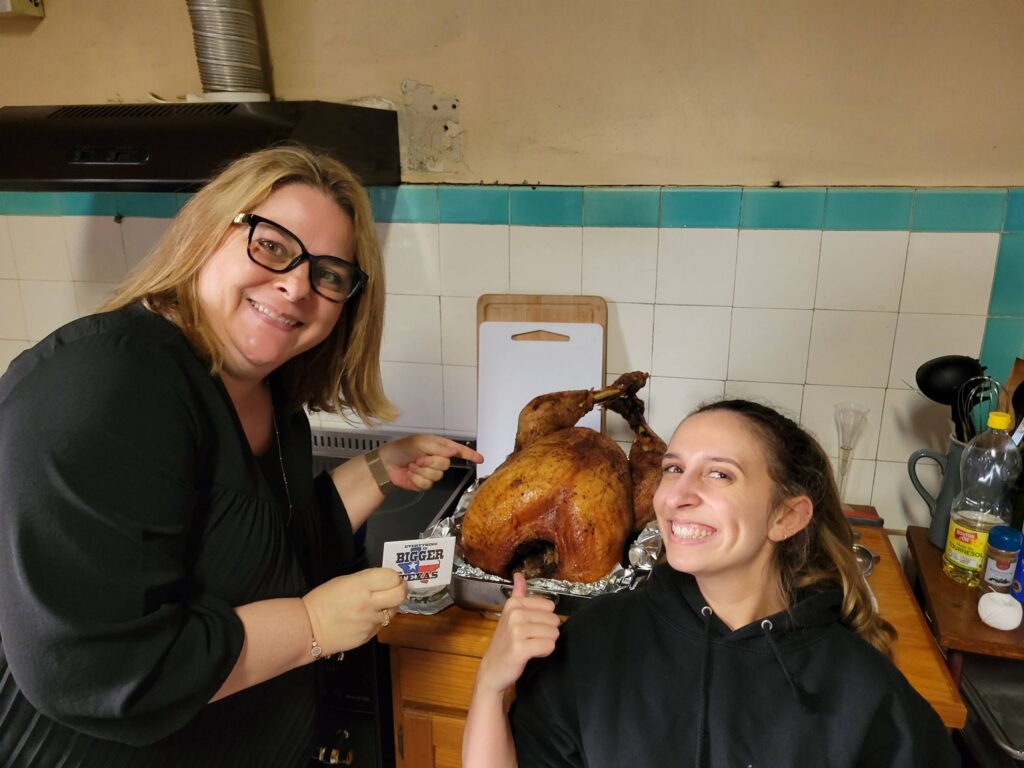
Local French friends crowding around our American Thanksgiving turkey last year — curious about our traditions, and generous about sharing theirs. These connections have come more naturally in a smaller town.
Of course, small towns come with real trade-offs. You give up convenience. You almost certainly need a car. The boulangerie closes at noon and isn’t open Sunday afternoon when you desperately need a baguette. Some smaller communities can be slower to trust outsiders, and speaking French — even imperfect French — goes a long way. But in exchange for those efforts, becoming genuinely part of a community feels more within reach.
The goal isn’t French friends — it’s good friends
This was my favorite point in Jay’s video, and the one that stuck with me most: the goal isn’t necessarily to make French friends. It’s to make good friends. The kind who show up when life gets hard and celebrate when it gets good. French or otherwise.
For us, those relationships have come from a mix of places — some French, some fellow internationals, some somewhere in between. That mix has been more meaningful than I expected.
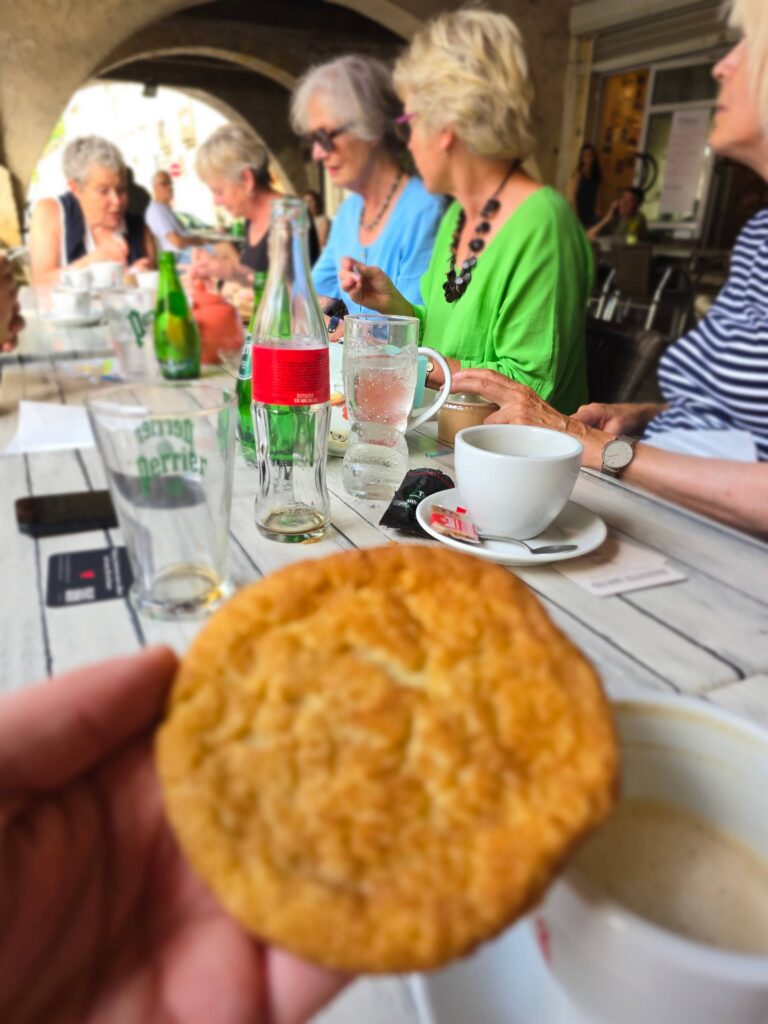
Coffee in Sainte-Foy-la-Grande with the Dordogne Ladies Club International. One of them brought me Snickerdoodles because she knows they remind me of childhood. A good mix of friends makes all the difference.
“The goal isn’t to make French friends. It’s to make good friends — the ones that weather the ups and downs of life with you.”
A practical trick: look for English bookstores
One thing I’ve started sharing with clients during relocation consults: if you’re researching an area and don’t yet speak French, and you want a sense of whether there will be people to socialize with in English, search for an English-language bookstore nearby.
If one exists, it’s a strong signal. It means there’s likely a cosmopolitan mix of both English-speaking internationals and French locals who are actively interested in English language and culture. Places like Bookie’s in Périgueux or The Little Bookshop in Rennes have become genuine social hubs — not just shops.
Worth knowing: France has around 3,500 independent bookstores — more than the U.S., in a fraction of the geographic space. Many have no online presence at all, so you won’t always find them with a search.
If you’re visiting a smaller town, step into the local librairie and see whether they carry even a small English section. Eymet’s does. That detail tells you something useful: not just that internationals live in the area, but that local French residents are open to and curious about English language and culture. When you’re still learning French, that kind of openness is a real foothold.
Wherever you end up, community finds you faster than you’d expect — if you keep showing up.
Baguettes and butter foreva — Raina ❤️
