


When we first arrived in France, the cheese aisle stopped us cold. Dozens of types, textures, and names we’d never seen — and smells we definitely weren’t prepared for. It was overwhelming in the best and most confusing way.
So I did what I always do when something new feels like too much: I bought a book.
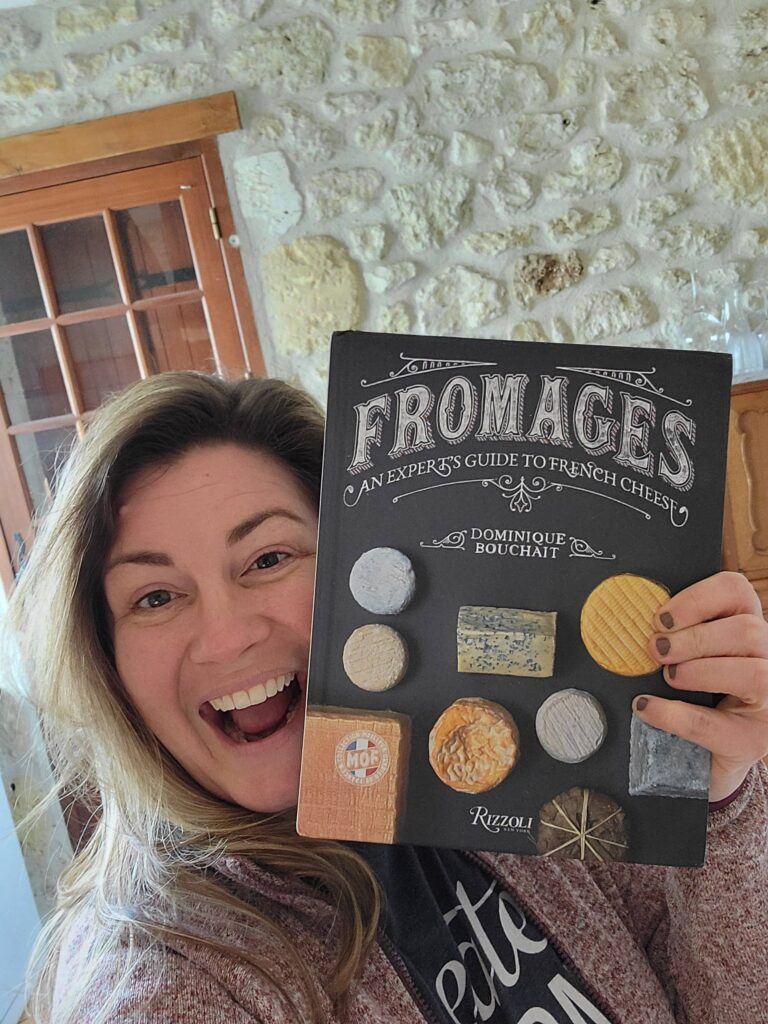
(Me, very excited about my new cheese education in March 2023)
Our Cheese Education
We started simply — look up a cheese in the book, buy it, taste it. Over time, that routine built a steady rotation of French cheeses we genuinely love. And that once-daunting wall of fromage at the store or market? It’s started to feel less like a test and more like an adventure.
Juliana felt so strongly about sharing this that she asked to make a video! I think it’s now her most famous video on the channel. 😂
Watch her Crash Course in French Cheese here.

(Behind-the-scenes peek!)
5 Things Americans Get Wrong
Juliana covered the big picture in the video, but here are a few things about how the French actually eat cheese that didn’t make the cut.
1. Cheese Is Never an Appetizer
Don’t expect a cheese board to greet you at the door of a French dinner party. It’s one of the meal’s courses, not an appetizer. The exception to this is sometimes the little cubed cheese you’ll see with the other prepared “apero” items at the grocery store. It’s often pre-cut into little squares and sold in a little plastic tub.
2. Cheese Comes After the Main Course
In France, cheese appears after the main dish and salad, just before dessert. At a three-course meal, guests sometimes choose cheese instead of dessert. Jason loves this when we eat out — it gives him a lower-carb finish to the meal that’s much easier on his diabetes than something sweet.
3. Serve Yourself — Just Cut It Right
At someone’s home, cheese is usually passed family-style, just like any other dish. If a plate arrives with several varieties, take only what you like. Nobody will judge your preferences — opinions on cheese run strong in France, and everyone has them.
The one rule: cut the cheese in a way that preserves its shape. The goal is to keep the rind evenly distributed from piece to piece, so the next person gets the same experience you did.
4. Try Eating the Rind (Unless It’s Wax)
Wax rinds are uncommon and not edible, but almost every other rind is fair game. It may look strange to American eyes, but eating the rind adds a whole new layer of complex flavor to the experience. In our family, we all have cheeses where we eat the rind and cheeses where we don’t — and we don’t always agree! Jason almost always eats his because he hates to waste a single bite. 😉Juliana and I are split depending on the cheese.
5. “Fancy” Cheese Is Surprisingly Affordable
Because cheese is an everyday food in France, the price reflects that. The full spread we used in the video — the one that looks very impressive — cost about 30 euros, with individual cheeses ranging from 1 to 5 euros each. In the US, that same board would likely run at least twice the price.
Pro Tip: How to Order at the Market
If you’re buying at a market and aren’t sure how much to ask for, just tell the vendor how many people you’re serving. They’ll show you the cut before slicing — and you can say “un peu plus” (a little more) or “un peu moins” (a little less) to adjust.
Whether you’re standing in a French supermarché, local outdoor market or an American specialty grocery store, we hope Juliana’s video gives you the confidence to reach for something new — and maybe even something a little stinky, in the best way. 😉
Baguettes and Butter 4ever, Raina, Jason, and Juliana ❤️
